
pool chemicals hard to balance: start by testing frequently, correct total alkalinity first, then adjust pH, restore free chlorine, maintain circulation and filtration, control cyanuric acid levels, remove organics, and use small measured doses; call a professional if metals, equipment failures, or persistent algae prevent stable chemistry.
pool chemicals hard to balance; noticed cloudy water or sudden algae after dosing? I’ve worked with Kissimmee homeowners, and with Jolly Family’s routine checks we pinpoint the causes and steady pools fast. Try a few of these practical fixes tonight.
common causes why pool chemicals stay unbalanced
Many backyard pools stay unbalanced because everyday events quietly change the water. pH, alkalinity, and chlorine react to heat, rain, swimmers, and debris, so small changes add up fast.
- Rain and dilution: Heavy rain lowers chlorine and can change pH and alkalinity. After storms, test and dose chlorine and alkalinity stabilizer.
- High bather load: More swimmers introduce sweat, sunscreen, and urine that consume chlorine and shift pH. Shock the pool and run the filter longer after busy days.
- Sunlight and heat: UV breaks down chlorine and raises pH during hot, sunny periods. Use stabilized chlorine or add cyanuric acid carefully to protect free chlorine.
- Organic debris and algae: Leaves, grass, and pollen use up sanitizer and create cloudy water. Skim and vacuum regularly; brush surfaces and maintain consistent chlorine levels.
- Poor circulation and filtration: Stagnant spots let chemicals remain uneven. Clean or backwash filters and ensure pump run time is adequate to turn over the pool at least once daily.
- Incorrect dosing or old chemicals: Overdosing one chemical without adjusting others causes swings. Also, expired or clumped chemicals perform poorly—store dry and replace old stock.
- Total hardness and metals: Very hard water or dissolved metals can cause scale, staining, and pH instability. Test for calcium hardness and metals, and treat with sequestrants or partial drain-and-refill if needed.
Key interactions to watch
Alkalinity buffers pH; low alkalinity makes pH jumpy, while high alkalinity can lock pH high. Keep total alkalinity in the recommended range first, then adjust pH. Also monitor cyanuric acid—too much reduces effective chlorine.
Quick checks: test in the morning and after heavy use, record values, and make single, small adjustments rather than large multi-chemical doses. Regular testing and small corrective steps keep levels stable and avoid the cycle of constant rebalancing.
how pH, alkalinity and chlorine interact: simple checks you can do
Simple checks help you see how pH, alkalinity, and chlorine influence each other. Test first, then act: small, measured changes keep levels steady and avoid chemical swings.
What to test and target ranges
- pH: aim for 7.2–7.6. pH outside this range makes chlorine less effective or irritates swimmers.
- Total alkalinity (TA): aim for 80–120 ppm. TA buffers pH and prevents sudden jumps.
- Free chlorine (FC): aim for 1–3 ppm for residential pools. Check combined chlorine (CC) — if CC > 0.5 ppm, you need to shock.
- Cyanuric acid (stabilizer): aim for 30–50 ppm. Too much reduces chlorine action.
- Calcium hardness: 200–400 ppm to avoid scaling or corrosion.
Step-by-step quick checks
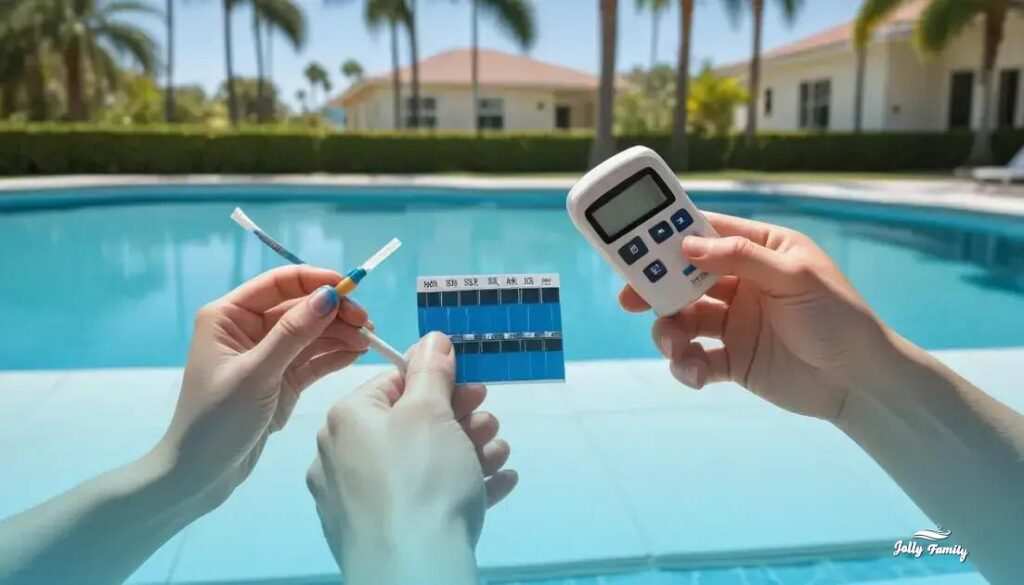
- Use a reliable test kit or digital photometer. Test for FC, CC, pH, TA, and stabilizer. Read results in sunlight and record values.
- If TA is out of range, correct it first. Low TA makes pH unstable; high TA can keep pH locked high.
- After TA is in range, adjust pH. To raise pH use soda ash; to lower pH use muriatic acid or sodium bisulfate. Add chemicals in small doses and let the system circulate.
- Adjust chlorine last. If FC is low, add regular chlorine or shock if CC is high. Re-test FC after several hours of circulation.
- When adding stabilizer (cyanuric acid), dose slowly and re-test after 24 hours; it builds up over time and is hard to lower quickly.
Practical tips for reliable results
- Make one change at a time and wait to retest. Rapid, multiple additions cause unpredictable interactions.
- Test in the morning and after heavy use or storms. Record results to spot trends.
- Keep chemicals dry and not expired; store them off the deck to avoid contamination.
- Maintain good circulation and clean filters. Poor flow hides local imbalances even when bulk numbers look fine.
- If you see persistent imbalance, check for hidden causes like metals, very high bather load, or water source hardness.
Following the test-adjust-test routine, with attention to TA first, pH second, then chlorine, makes balancing faster and prevents repeated corrections that waste time and chemicals.
quick troubleshooting steps: tools, tests and adjustments for first response
- Essential tools: digital photometer or reliable test strips, a test kit for TA and CYA, measuring scoop, protective gloves, and a notebook for results.
- Safety first: wear gloves and eye protection. Add chemicals to water, never water to chemicals.
Quick test sequence
- Test first: measure free chlorine (FC), combined chlorine (CC), pH, total alkalinity (TA), and cyanuric acid (CYA). Record values.
- If TA is outside 80–120 ppm, correct it before changing pH. Low TA makes pH unstable; high TA can lock pH high.
- Adjust pH next. To raise pH use soda ash in small doses; to lower pH use muriatic acid or sodium bisulfate carefully.
- Fix chlorine last. If CC > 0.5 ppm, shock the pool. If FC is low, add regular chlorine and run the pump.
- Always make one change at a time, wait 4–6 hours with circulation, then retest.
Fast adjustments for common problems
- Low chlorine after a storm or party: boost FC with regular chlorine and run the filter longer; consider shocking if water is cloudy or CC is high.
- pH drifting up on sunny days: add small amounts of acid in the evening and test the next morning.
- Cloudy water with normal numbers: check filter pressure, clean or backwash, and use a clarifier while maintaining proper FC.
- Persistent algae: brush surfaces, raise chlorine with shock, and maintain circulation until water clears.
Follow-up checks
- Run the pump at least 8–12 hours after adjustments to mix chemicals fully.
- Retest in the morning and again after 24 hours. Track readings to spot trends.
- If levels bounce back quickly, inspect for hidden causes like metal contamination, very high bather load, or poor circulation.
Fast troubleshooting uses a simple loop: test → fix one issue → circulate → retest. This approach saves time, avoids over-dosing, and gets water back to safe levels quickly.
preventive routine: weekly checklist to keep chemical levels steady in Kissimmee
In Kissimmee’s heat, follow a simple weekly routine to prevent swings: test often, record numbers, and make small corrections.
Weekly checklist
- Test water (2× per week): check free chlorine, pH, total alkalinity (TA), and cyanuric acid (CYA). Record each result in a notebook or app.
- Adjust alkalinity first: if TA is outside 80–120 ppm, correct it before touching pH. Use sodium bicarbonate to raise TA or a TA reducer to lower it.
- Set pH next: keep pH at 7.2–7.6. Add small doses of soda ash to raise or muriatic acid/sodium bisulfate to lower. Wait and retest after circulation.
- Maintain chlorine: aim for 1–3 ppm free chlorine. Add routine chlorine or shock after heavy use, storms, or if combined chlorine is >0.5 ppm.
- Run the pump: ensure at least 8–12 hours of circulation daily in hot months to mix chemicals and prevent hot-spot imbalances.
- Skim and clean: remove leaves and debris from the surface and skimmer baskets to reduce organic load that consumes chlorine.
- Check filter and pressure: clean or backwash when pressure rises 8–10 psi above normal. A dirty filter masks chemical issues.
Monthly and seasonal checks
- Test CYA monthly: keep CYA near 30–50 ppm in outdoor pools. High CYA reduces chlorine effectiveness; lower it via partial drain-and-fill if needed.
- Check calcium hardness: test every few months and aim for 200–400 ppm to avoid scale or corrosion.
- Inspect equipment: look for leaks, worn seals, or a noisy pump. Fixing circulation problems prevents chemical swings.
Practical tips
- Make one change at a time: wait 4–6 hours and retest before adding another chemical.
- Log trends: a simple chart helps spot slow shifts after storms or events.
- Respond after events: test and adjust after heavy rain, pool parties, or long heat spells.
- Store chemicals properly: keep dry, cool, and sealed to preserve strength.
Consistent testing, small adjustments, and routine equipment care keep pool chemistry steady in Kissimmee’s warm climate.
when to call a pro: how Jolly Family solves stubborn imbalances reliably
Call a pro when chemical levels keep bouncing back after repeated fixes, when you see stains or scale, or if algae returns quickly despite correct readings. Other red flags are strong chlorine smell, swimmer irritation, cloudy water with normal test results, or equipment that won’t maintain flow.
What a professional will check
- Full water analysis: metals, phosphates, cyanuric acid (CYA), calcium hardness, and detailed chlorine speciation.
- Equipment and flow: pump output, filter condition, skimmer function, and any clogged lines or failing valves.
- Hidden causes: source water hardness, pool plaster or surface issues, automatic feeders, and signs of leaks or contamination.
How Jolly Family solves stubborn imbalances
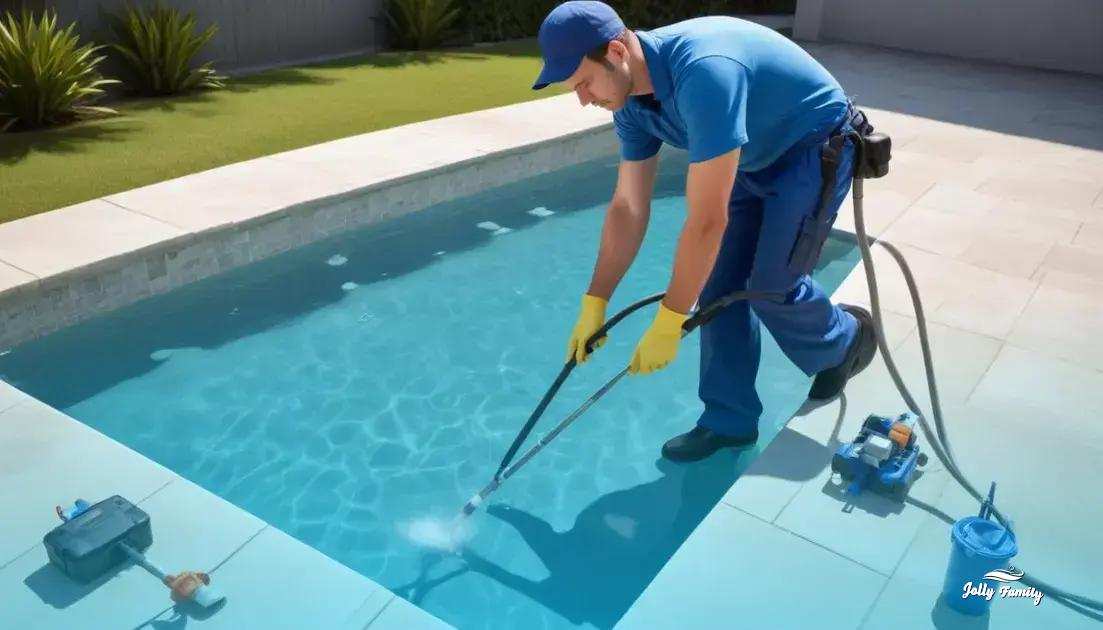
Jolly Family starts with a field-grade test and documents baseline numbers. They use targeted treatments like metal sequestrants, enzyme cleaners, or non-chlorine oxidizers when needed. Mechanical fixes come next: filter cleaning, pump tuning, or replacing worn seals to restore proper circulation.
- Stepwise treatment: correct alkalinity, adjust pH, address metals or phosphates, then restore free chlorine with shock if required.
- When needed, drain-and-refill: used as a last resort for very high CYA or extreme hardness that won’t respond to chemical correction.
- Follow-up and training: a follow-up visit confirms stability and staff or homeowner get simple care tips to avoid repeat issues.
Pros also provide clear estimates and explain why a problem happened. Ask for documentation of tests and a simple maintenance plan so you know what to watch for.
Keep your pool balanced with simple habits
Test regularly — check pH, total alkalinity, and free chlorine at least twice a week and after storms or parties.
Make one small adjustment at a time, run the pump 8–12 hours to mix chemicals, then retest. This avoids big swings and wasted chemicals.
If levels keep bouncing back, or you notice stains, persistent algae, or swimmer irritation, call a pro to check for metals, equipment faults, or hidden contamination.
With steady testing, small fixes, and routine equipment care, you can keep pool water clear, safe, and ready to enjoy. Keep a simple log and act quickly when numbers change.
FAQ – Pool chemicals hard to balance
How often should I test my pool water?
Test at least twice a week and after heavy rain, parties, or long heat spells. Keep a log to track changes.
Why does my pH keep rising?
Sunlight and high alkalinity can push pH up. Check and correct total alkalinity first, then adjust pH in small steps.
When should I shock the pool?
Shock when combined chlorine (CC) is over 0.5 ppm, after a big party, or if water is cloudy or shows algae.
How do I fix unstable chemical levels?
Make one change at a time: correct TA (80–120 ppm), adjust pH (7.2–7.6), then restore free chlorine. Circulate and retest.
Can high cyanuric acid (CYA) cause imbalance?
Yes. CYA over 50 ppm reduces chlorine effectiveness. Lower CYA with partial drain-and-refill when needed.
When should I call a professional?
Contact a pro if levels bounce back after fixes, stains or scale appear, persistent algae returns, or equipment fails to maintain flow.